
Many Small Lights
Jung asks what the hidden parts of the mind are like, where consciousness begins and whether the "I" is really the owner of the psyche.
You drive home and arrive with no memory of the journey, yet somebody steered the car. You are irritable all day and only at nine in the evening work out why, yet the reason was in you the whole time.
In both cases part of your mind was at work without the part that says "I" knowing about it.
The middle of Jung's book asks what that hidden part is like, and it ends with a picture of the mind worth keeping: not one light, but many.
Where we are
In the first post Jung argued that the unconscious is real and has a history.
Now, in the middle of the book, he asks the harder questions: what is it like, where does it begin, and how does it fit with the mind we know?
He takes four steps, and the fourth is the one to remember.
The mind is bigger than we thought
Admitting an unconscious, Jung says, changed what the word "mind" means.
The psyche, his word for the whole mind, the conscious and unconscious parts together, had been treated as a finished object, something a philosopher could define from an armchair.
Now it came out of its chrysalis as something half known and half unknown, to be studied like any other natural thing: from its effects, patiently, without assuming we already know what it is.
The mind can come apart
How does something end up unconscious?
Jung sees two routes. Some things are pushed out because they hurt. Others never had enough energy to get in: the sound you did not notice, the mood you did not register.
Either way, the mind is not one solid block. It is dissociable: it can come apart into pieces.
Jung calls the pieces complexes: knots of memory and feeling gathered around one sore point.
A complex can behave like a small independent person inside you. Older cultures called such pieces spirits.
At the very bottom, Jung adds, lie processes so far from consciousness that they can never be brought up at all. He calls them "psychoid": mind-like, bordering on the body.
Where does the mind begin?
If the psyche shades off into the body, where does it start?
Jung's answer uses instinct and will. Instinct is automatic: it fires all at once, like a reflex, and cannot be argued with. Will is energy the "I" can direct.
The psyche, he proposes, begins where instinct stops being automatic and can be modified by the will.
It is a good definition with a trap in it.
If the psyche is whatever the will can reach, then the psyche is simply consciousness and the unconscious is not part of the mind at all.
Jung prints the contradiction rather than hiding it.
The way out: many small lights
First Jung says what kind of claim he is making. Physicists learned to describe light as both wave and particle. A model, he says, does not claim that something is so. It shows one way of looking.
Then he asks what happens to a thought when it drops out of sight.
Nothing, he answers, except that it is no longer connected to the "I". Down there it goes on perceiving, feeling and wanting, as if someone were present.
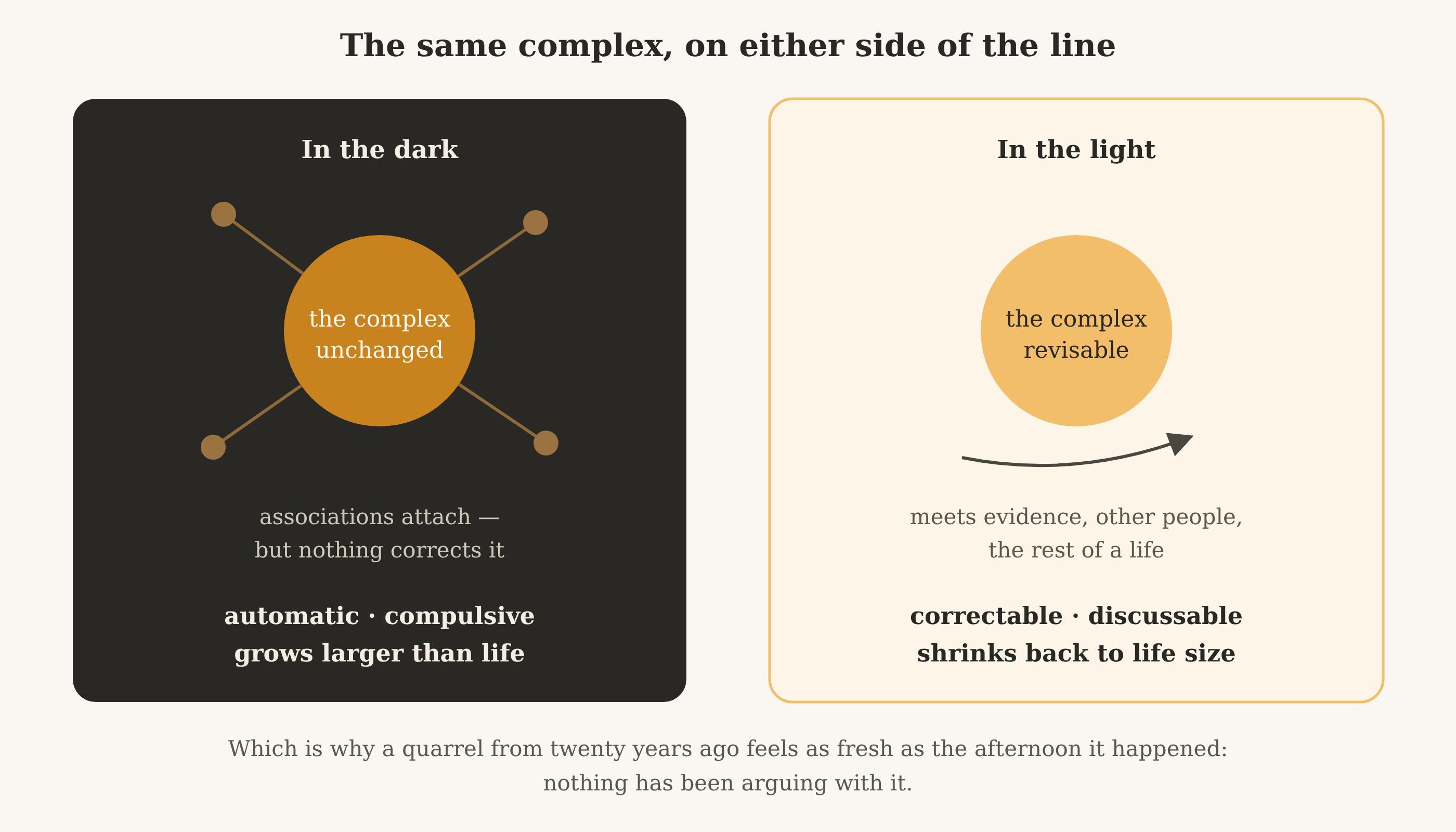
In the dark a complex can grow but cannot be corrected. Unconscious keeps; conscious corrects.
It keeps collecting whatever fits it and never meets anything that argues with it.
That is why a quarrel from twenty years ago feels as fresh as the afternoon it happened: life has moved on, and none of it reached the complex.
This is why bringing something into the open helps, not by magic, but because only there can it be revised.
And the further out a thing lies, the more it swells, taking on a larger-than-life, mythic quality. Jung pictures it sliding towards the red end of the spectrum, red being the colour of blood and instinct.
Now the move that gets him out of the trap.
Consciousness, he says, is not something you either have or lack. It comes in degrees.
Between "I do this" and "I am conscious of doing this" there is a world of difference. Think of the drive home again.
Nothing in you is ever entirely conscious, and perhaps nothing is ever entirely unconscious.
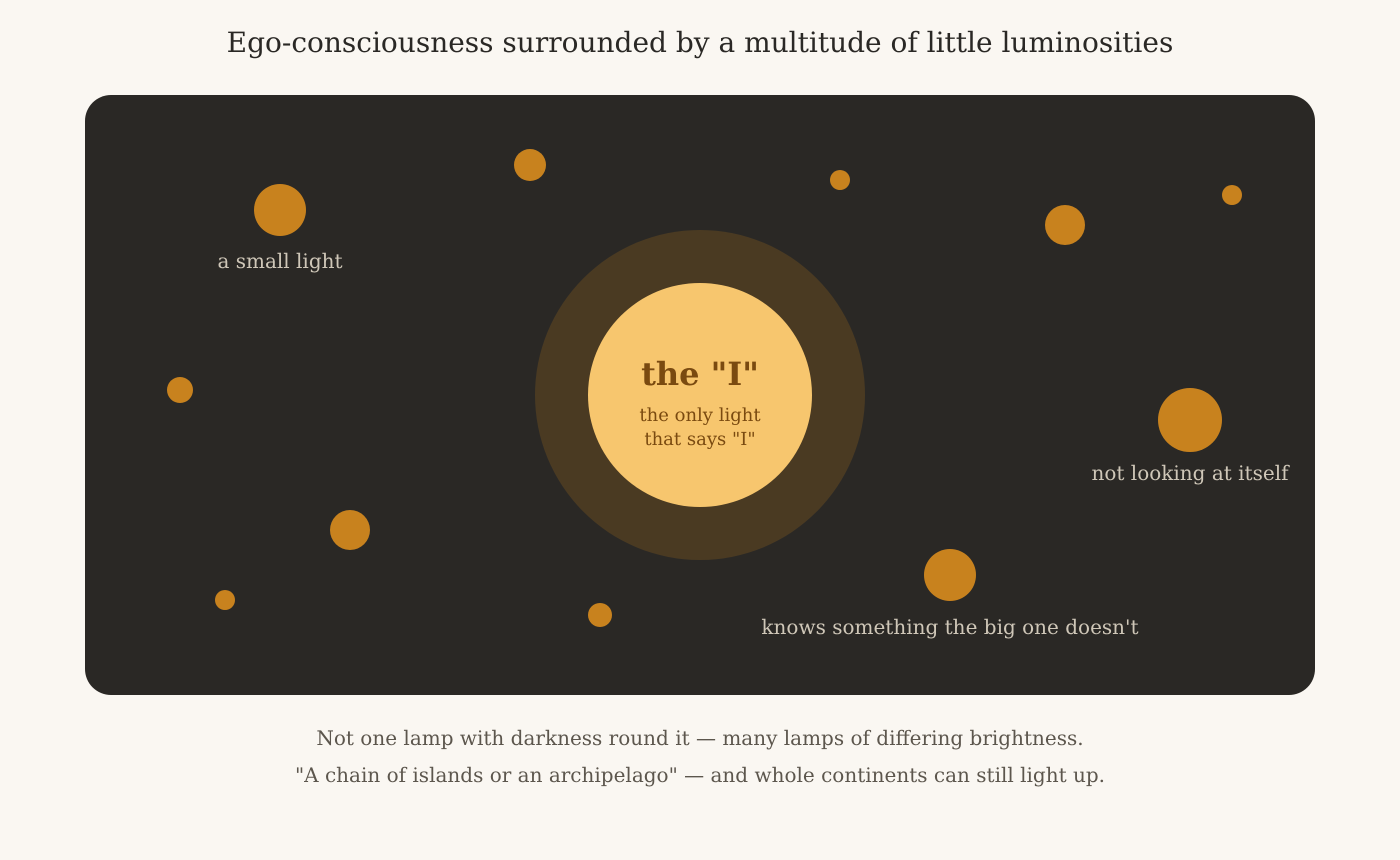
So instead of a second "I" hidden inside us, Jung proposes something in between: a dimmer kind of awareness that does not look back at itself, the kind you can see in a dog.
Picture the mind as a dark sea at night.
One large bright island, the "I", which Jung calls the ego, is the only light that says "I". Around it lie many smaller lights, flickering on wherever a feeling or an instinct wakes one: a chain of islands, an archipelago.
New islands, even continents, can still light up.
The "I" is not the owner of the mind, only its brightest island, and some of the smaller lights know things it does not, like the part of you that knew months ago that the job was wrong.
Two questions to leave open
Think of a grievance that still arrives in the same words each time it comes up, though everything around it has changed. Is putting it into words enough to bring it into the light, or can something be talked about endlessly and never meet anything that argues with it?
Think of a decision you made long after some part of you had already made it: leaving a job, ending a friendship, moving house. Which island knew? If the smaller lights know things the "I" does not, how do you listen to them without handing them the wheel?
Section 6, paragraphs 388-396, where Jung borrows the alchemists' sparks and asks whether the unconscious is itself a kind of consciousness.
Reading Jung together
These articles are an invitation to read slowly and think alongside the text. If a passage raises a question or a different interpretation for you, that question may itself be worth exploring.