The Unconscious in Historical Perspective
The first stage of a slow reading of C.G. Jung's On the Nature of the Psyche, exploring why the unconscious was resisted for so long and what that resistance may itself tell us about the psyche.
The book I am starting with
The first book we will read together is On the Nature of the Psyche by Carl Gustav Jung (1875-1961), the Swiss psychiatrist who founded analytical psychology.
It is not one of his famous titles, but it is one of his densest. Jung first gave it as a lecture in 1946, at the Eranos conferences in Ascona, Switzerland, under the title The Spirit of Psychology; he revised and expanded it in 1954.
In English it is found in volume 8 of his Collected Works, translated by R. F. C. Hull, where its paragraphs are numbered 343 to 442. I will use those paragraph numbers throughout this series so that anyone with the book can follow.
We will take it slowly
In about a hundred pages Jung tries to say, as clearly as he ever did, what the psyche is: how consciousness and the unconscious relate, what instincts and archetypes are, and where the limits of psychology lie. It has eight short chapters. We will take them slowly.
Psyche
"Psyche" is simply the Greek word for soul or mind. Jung uses it for the whole of our mental life, conscious and unconscious together.
The unconscious
"The unconscious" means everything going on in the psyche that we are not aware of at the time.
The Unconscious in Historical Perspective
The first chapter is a short history - but a history with an argument inside it. Jung wants to explain why the unconscious was resisted for so long, and his answer is that the resistance was itself psychological.
The instrument nobody looked at
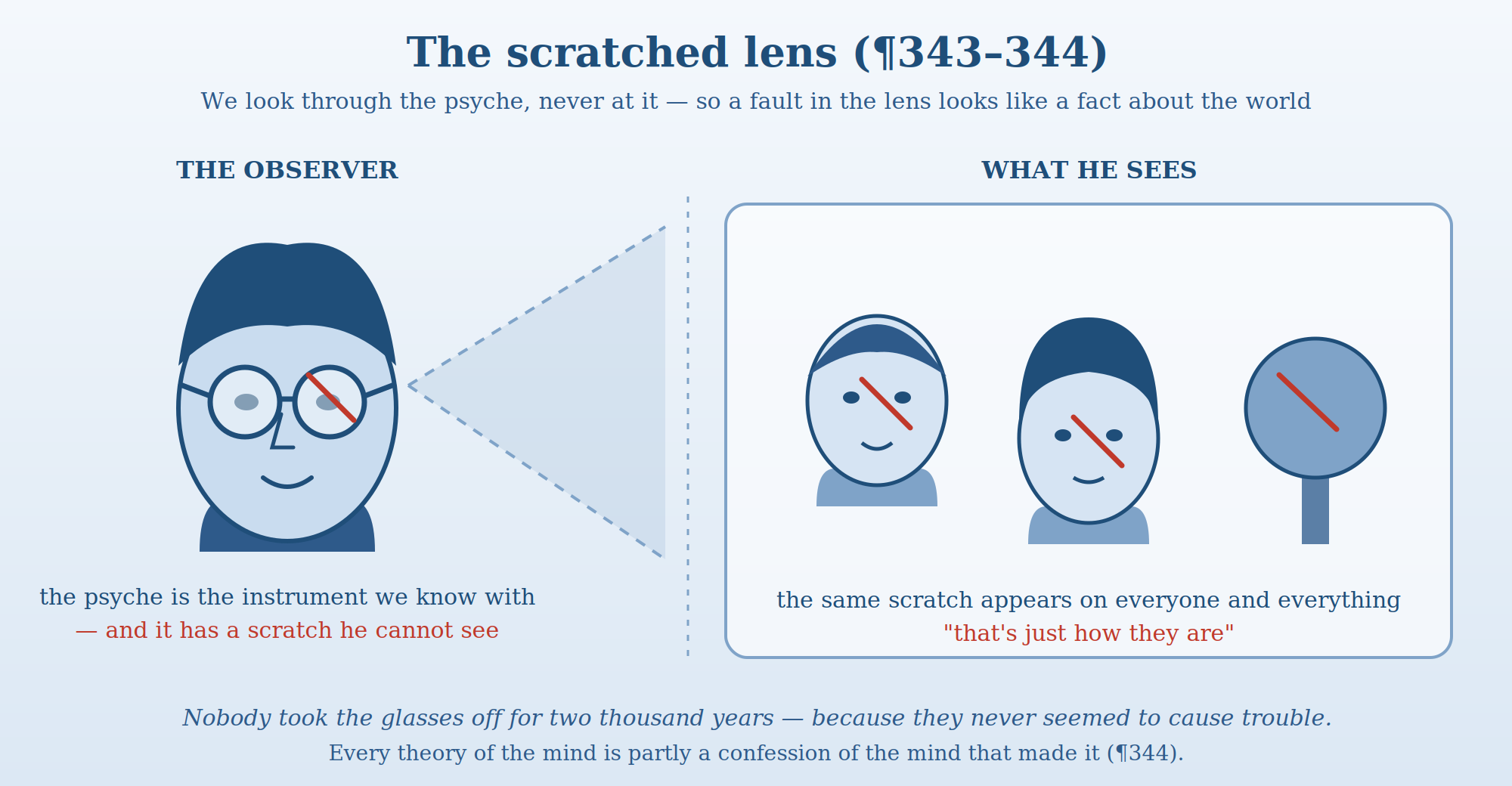
Paragraph 343For about two thousand years, up to the seventeenth century, people wrote a great deal about the soul, but the soul itself was never examined.
Why? Because the mind is the instrument with which we know everything else. We look through it, never at it - like glasses.
And because it never gave trouble, it was assumed to be already known: "the best known of all knowables."
Jung adds that this naivety is still with us. Almost everyone, including the psychologist, quietly assumes that other people's minds work like their own.
Every theory is a confession
Paragraph 344The old thinkers never suspected that their doctrines about the soul were themselves products of the soul.
They believed reason could lift them to a place above the psyche. Jung, following the German philosopher Friedrich Nietzsche (1844-1900), denies that any such place exists: every statement about the mind is, at least in part, a confession by the mind that made it.
He then draws a surprising consequence. People are alike only in so far as they are unconscious. The more a person's consciousness develops, the more individual, less predictable and freer they become - and the less they fit what the group expects.
Truth by majority
Paragraph 345In everyday life, "true" and "valid" mostly mean "believed by most people."
Once minds begin to differ, argument stops settling anything - and that is what happened to European philosophy.
The only way out was to stop arguing and start looking at experience. This is how psychology was born as an empirical science.
Christian von Wolff (1679-1754), a German philosopher, was the first to speak of "empirical psychology" in the 1730s.
The unwanted lodger
Paragraphs 346-347The escape was only half made. Philosophy kept control of "rational" psychology; the subject stayed inside the philosophy faculty; the psychology that came from the clinic had to beg shelter from medicine.
"The situation," Jung says, "is still largely medieval."
Then comes the chapter's boldest move: the academy behaves like a mind that has inhibited one of its own functions.
It admits only what fits its ruling attitude, denies that the rest exists, and pushes the inconvenient part into a basement - psychopathology stored as "a curious appendix to psychiatry."
The gatekeeper speaks
Paragraphs 348-349Jung lets the opposition talk in its own words.
Wilhelm Wundt (1832-1920) was the German physiologist who opened the first psychology laboratory, in Leipzig in 1879, and is usually called the founder of scientific psychology.
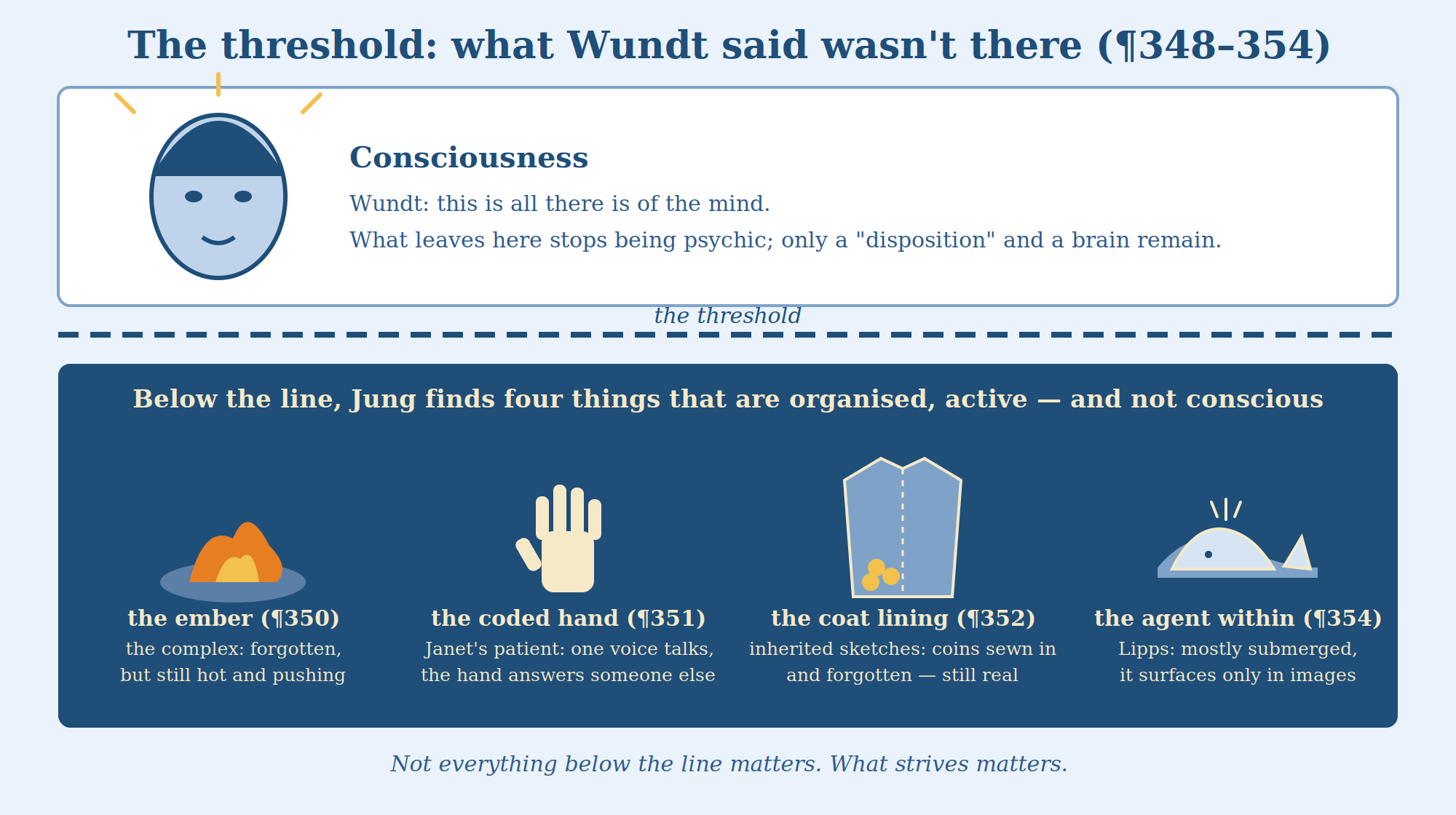
For Wundt, what leaves consciousness stops being psychic; all that remains is a "disposition", a bare possibility of coming back, carried by the brain.
Only the conscious is psychic; below that is body; so there is no unconscious.
Jung's reply: this assumes the very thing in dispute.
Ash or ember
Paragraph 350Johann Friedrich Herbart (1776-1841), a German philosopher who succeeded Kant in his chair at Königsberg, had claimed that a forgotten idea lives on below the threshold and strives to return.
Jung says this is wrong for ordinary forgetting - where you parked last year is cold ash - but exactly right if you replace "idea" with complex: a cluster of feeling-charged contents that presses, intrudes and returns in dreams and slips.
Not everything below the threshold matters; what strives matters.
The coded hand
Paragraph 351Wundt's last defence was that there are no unconscious contents, only dimly conscious ones; two consciousnesses in one person would have to run at the same time, which he said never happens.
Pierre Janet (1859-1947), a French doctor at the Salpêtrière hospital in Paris who studied dissociation before Freud, had already shown that it does: a patient talking with one person while her hand answered another observer in code - two organised streams, one moment.
A representation nobody has
Paragraph 352What really horrified Wundt, Jung says, was the idea of a "representation" - a mental picture - that no one is picturing.
So Jung coins a neutral word, contents, and plants the deepest seed in the book: even unconscious contents carry a faint trace of being "seen", which raises the possibility of an unconscious subject that is not the "I".
He also answers Wundt's mockery of inborn ideas: what is inherited is not pictures but sketches, patterns of behaviour - as real as a hundred coins sewn into a coat lining and forgotten, an image borrowed from the philosopher Immanuel Kant (1724-1804).
Allies and erasures
Paragraphs 353-355Jung was not alone, and he closes by naming his allies.
Adolf Bastian (1826-1905), a German traveller and anthropologist, had found the same basic forms of imagination in every people - more or less what we now call archetypes.
Theodor Lipps (1851-1914), a German philosopher and psychologist, had said that psychic life proceeds unconsciously most of the time, and only at special points does "the agent within us" show itself, in images.
Yet the resistance was so strong that a standard history of German psychology did not even mention Carus and von Hartmann, the two philosophers who had written whole books on the unconscious.
What cannot be refuted can still be left unmentioned.
The central thought from Chapter 1
The unconscious was not discovered late because it was hidden; it was resisted, and the resistance was the psyche defending itself against being looked at.
Three questions to sit with
- Where do I assume other people think as I do?
- What, in my own life, is the part I say I "simply am not"?
- What forgotten thing is ash, and what is ember?
What did you make of Chapter 1?
This series is intended to be read as a conversation rather than simply a set of summaries. If something here made sense to you, puzzled you, or made you think differently about your own experience, I would be very interested to hear from you.
You are welcome to send me a question, comment or reflection. Reader questions may also help shape what I explore as we continue through On the Nature of the Psyche chapter by chapter.
A question, disagreement or thought is welcome
Reading Jung Together is intended to encourage reflection and discussion. If this chapter has raised a question, prompted a thought or made you curious about something Francesco has written, you are welcome to get in touch.